

Broad Coalition Delivers Historic Victory in Frisco Mayoral Runoff

Share
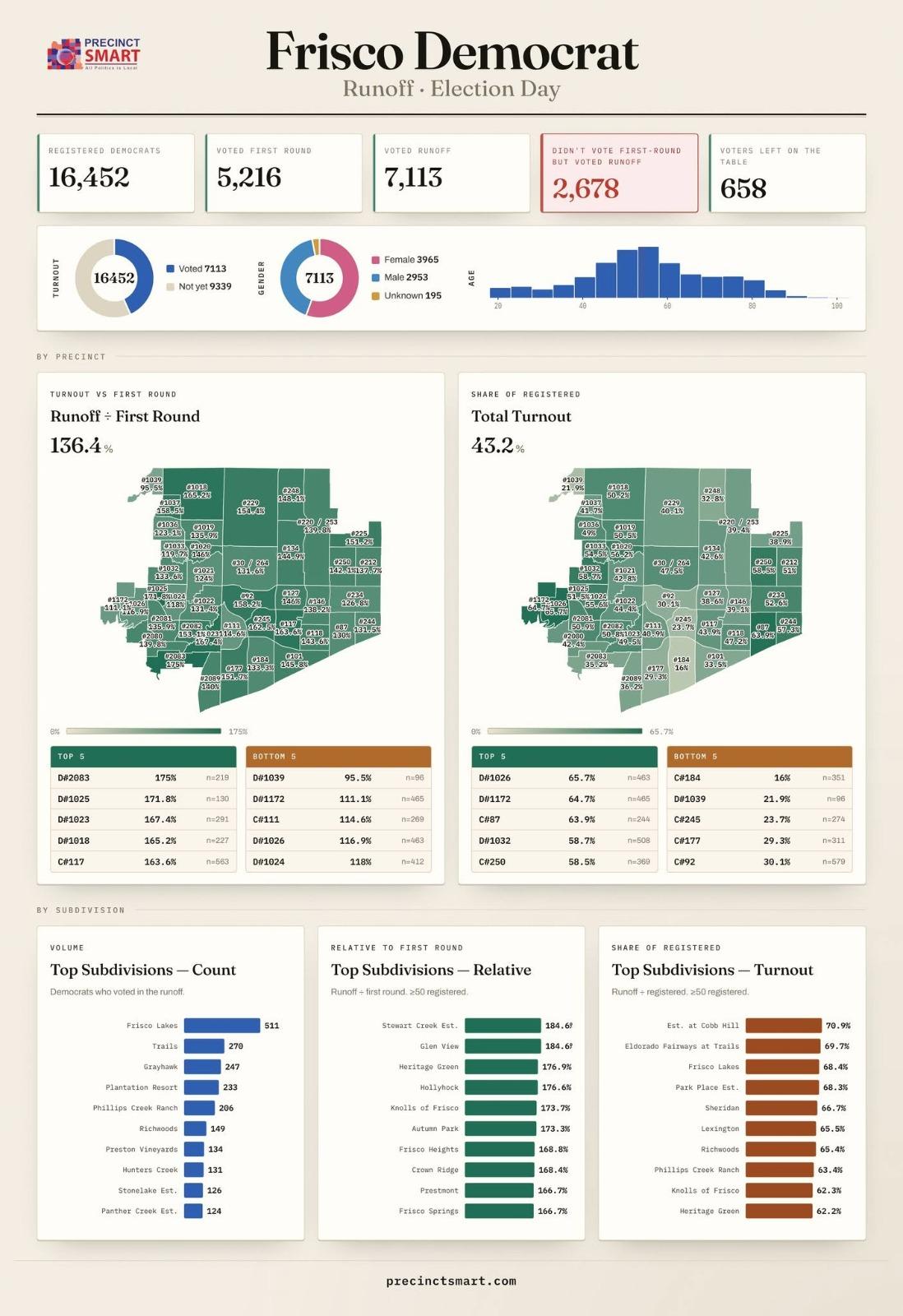
FRISCO, Texas — The final results of Frisco’s mayoral runoff tell a story that goes far beyond party labels. They reveal the growing influence of civic engagement, coalition-building, and community participation in shaping the future of one of Texas’ fastest-growing cities.
According to turnout data, Republican voters cast approximately 10,456 votes in the runoff, while 7,113 Democrats participated despite having no Democratic candidate on the ballot. Throughout the campaign, one benchmark stood out: if Democratic turnout could reach roughly 70% of Republican turnout—up significantly from about 51% in the first round—the race would become highly competitive. In the end, Democrats reached nearly 68% of Republican turnout, a level that proved decisive in helping elect Mark Hill as Frisco’s next mayor.
The numbers demonstrate an important political reality in Frisco: elections are increasingly being decided not by one group alone, but by broad coalitions of voters working together around shared concerns for the city’s future.
One of the most significant developments in this election was the extraordinary participation of South Asian and Desi voters, including large numbers of Muslim and Hindu residents. These communities have grown rapidly alongside Frisco itself and have become an increasingly important part of the city’s civic fabric. Their turnout, combined with strong participation from Democratic voters and support from moderate Republicans and independents, helped create one of the broadest electoral coalitions Frisco has seen in recent memory.
The runoff data highlights this engagement. Democratic turnout surged compared with the first round, with thousands of voters returning to the polls despite having no direct partisan stake in the contest. Their decision to participate reflected a belief that local elections matter and that leadership at City Hall has a direct impact on community relations, public discourse, economic development, and quality of life.
For many residents, this election was also about preserving a welcoming and inclusive atmosphere in Frisco. Voters from diverse backgrounds came together around a vision of stability, respect, and constructive civic leadership. The result demonstrated that communities often portrayed as politically different can unite when they share common goals for their city.
Perhaps the most enduring lesson from this runoff is that civic engagement works. Every community that participated—from longtime Frisco families to newer residents, from Democrats to moderate Republicans, from Muslim, Hindu, and other faith communities—helped shape the outcome.
The election will be remembered not simply as a victory for one candidate, but as a demonstration of what can happen when a broad coalition of engaged citizens shows up, votes, and makes its voice heard. Frisco’s future was shaped by that participation, and the city is stronger for it.