

Beyond the Vote Count: The Coalition That Elected Frisco’s Mayor

Share
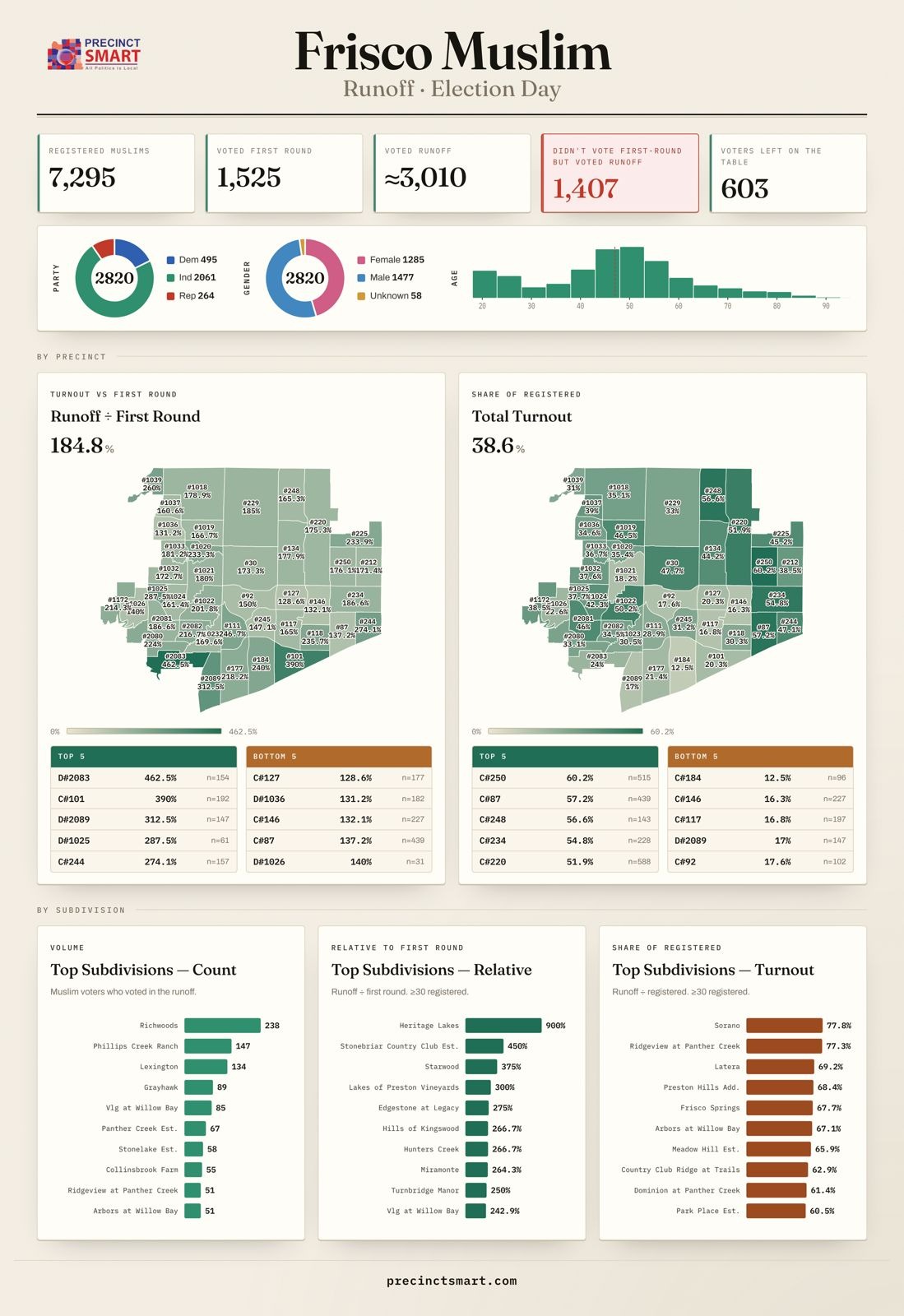
The final results of Frisco’s mayoral election tell a story that goes well beyond campaign slogans and election-night vote totals. They offer an important lesson about coalition-building, voter engagement, turnout, and the growing influence of organized communities in local politics.
Frisco had approximately 133,000 registered voters, yet only 33,778 residents cast ballots, resulting in a citywide turnout of 25.4%. As is often the case in municipal elections, participation was relatively low, making voter mobilization and community organization especially important factors in determining the outcome.
Among the various communities that participated in the election, the Muslim community stood out for its level of engagement. Of roughly 7,000 eligible Muslim voters in Frisco, an estimated 3,000 cast ballots, representing a turnout rate of approximately 43%—significantly higher than the citywide average.
Those numbers are noteworthy on their own. Their significance becomes even clearer when viewed in the context of the final election results.
The estimated 3,000 Muslim votes cast for Mark Hill represented approximately 9.2% of all ballots cast citywide. They also accounted for roughly 57% of Hill’s 5,486-vote margin of victory. While no single community elected the mayor on its own, the Muslim vote provided a substantial and highly organized component of the winning coalition.
However, reducing the election outcome to a single voting bloc would overlook the broader coalition that ultimately secured victory. Mark Hill’s success reflected support from multiple communities and political constituencies across Frisco.
The city’s Indian Hindu community, estimated to have contributed approximately 4,600 votes, appears to have split its support between the candidates, with roughly 60% backing Hill and 40% supporting Roden. That division still produced a meaningful net advantage for Hill and demonstrated that support extended beyond any one ethnic or religious group.
Democratic and independent voters also played an important role. Many voters who prioritized issues such as inclusion, community engagement, responsible growth, and pragmatic governance rallied behind Hill’s campaign. Their participation helped expand his coalition beyond traditional partisan or demographic boundaries.
At the same time, Hill attracted a significant share of moderate Republican voters. Estimates suggest he received approximately 35% of the moderate Republican vote, an important achievement in a city where Republican voters remain a major part of the electorate. This crossover support further broadened his base and reinforced the coalition that carried him to victory.
Taken together, these voting patterns reveal a classic example of a successful “grand coalition.” Rather than relying on a single constituency, Hill assembled support from Muslims, Indian Hindus, Democrats, independents, moderate Republicans, and other residents who found common ground around his campaign.
The Muslim community’s contribution extended far beyond voting. Volunteers participated in sign placement, voter outreach, phone banking, community education, and grassroots mobilization throughout the campaign. A Muslim political action committee reportedly raised approximately $50,000 to support these efforts and encourage civic participation.
These activities illustrate an important principle of local politics: influence is not determined solely by population size. Communities gain influence when they organize, educate voters, volunteer, raise resources, and consistently participate in elections.
The Frisco mayoral race demonstrates how civic engagement can translate into political impact. The Muslim community’s high turnout and organizational efforts made it an important contributor to the election outcome. At the same time, the broader coalition of Democrats, independents, Indian Hindus, moderate Republicans, and other engaged residents provided the diverse support necessary to secure victory.
Ultimately, the election serves as a reminder that local politics rewards participation. Communities that consistently volunteer, organize, communicate with voters, and show up at the ballot box earn a stronger voice in the democratic process.
In Frisco, a broad coalition of engaged citizens transformed civic participation into political influence, creating a model that future candidates will study closely. The lesson is straightforward: in local elections, organization, turnout, and coalition-building often matter more than raw population numbers alone.