Collin County’s Justice of the Peace Precinct 3 Race Expected to Be One of the Most Competitive in Years

Share
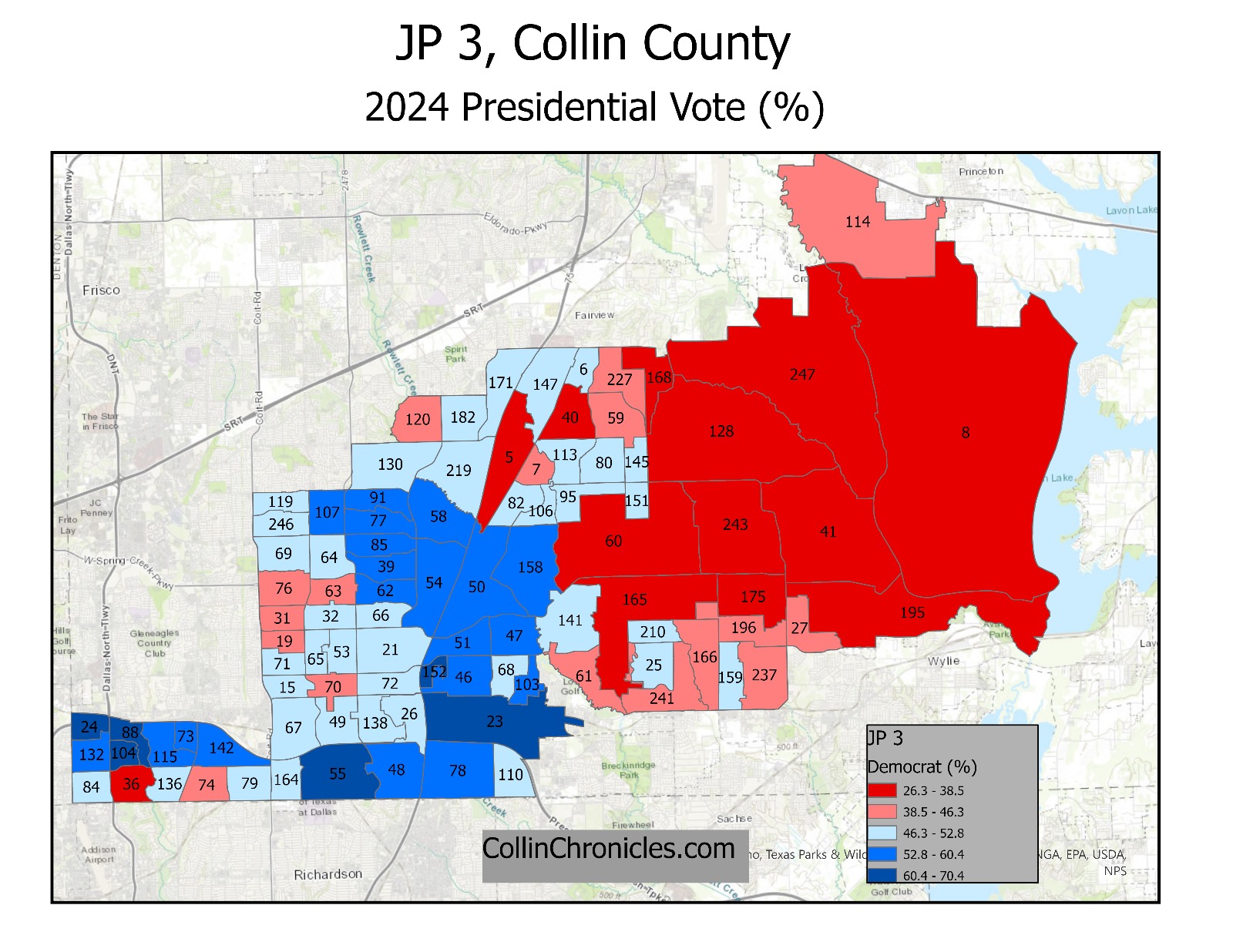
Collin County’s Justice of the Peace Precinct 3 race is shaping up to be one of the most closely watched local contests of the upcoming election cycle, reflecting broader political shifts taking place across North Texas. Long considered a reliably conservative area, Precinct 3 has become increasingly competitive in recent years as population growth, demographic change, and fluctuating voter turnout have created a more dynamic political landscape.
The most recent presidential results highlight just how tight the margins have become. In Precinct 3, Donald Trump received roughly 86,000 votes, while Kamala Harris received approximately 82,000 votes—a difference far smaller than the margins seen in previous elections. Analysts note that although the precinct still leans Republican, the narrowing gap demonstrates that voting patterns are evolving.
One of the most notable observations from the recent election cycle is the significant number of voters who participated in 2020 but did not turn out this time. This trend occurred across multiple neighborhoods and communities within the precinct, including areas that traditionally show high participation in presidential years. While turnout fluctuations between election cycles are common, the scale of non-participation surprised many local observers.
Community leaders, political analysts, and campaign organizers point to several factors that may have contributed to the drop-off. Some cite voter fatigue following a contentious national political climate. Others mention the lower visibility of down-ballot races and the challenges of mobilizing voters in non-presidential elections. Rapid population growth in cities such as McKinney, Allen, and parts of Plano has also created precincts where new residents may not yet be fully incorporated into local political networks.
Despite the lower turnout this cycle, various community organizations across Collin County report that engagement is rising again as the next election approaches. New voter registration drives, civic forums, and local issue-based advocacy groups have been more active in recent months. Several neighborhoods that saw reduced participation in the last cycle are expected to see increased interest this time, according to local civic groups.
All these factors contribute to growing speculation that the JP Precinct 3 race could be one of the most competitive in Collin County. The office of Justice of the Peace, though often overshadowed by higher-profile races, plays an important role in everyday community matters such as small claims, evictions, truancy cases, and administrative hearings. As growth continues in Collin County, the responsibilities of JP courts have expanded, increasing public attention on these positions.
Political scientists note that closely divided vote totals, combined with shifting turnout patterns, typically indicate a district in transition. Precinct 3 appears to reflect that pattern. With thousands of new households, changing local priorities, and a growing voter base, the upcoming contest is expected to draw significant attention from both parties and from independent voters.
As Collin County continues to grow and diversify, races like JP Precinct 3 offer a window into the evolving political character of North Texas—one where margins are narrowing, voter engagement is shifting, and local elections are becoming increasingly competitive