

The future of elections in Collin County may be decided less by persuasion and more by participation

Share
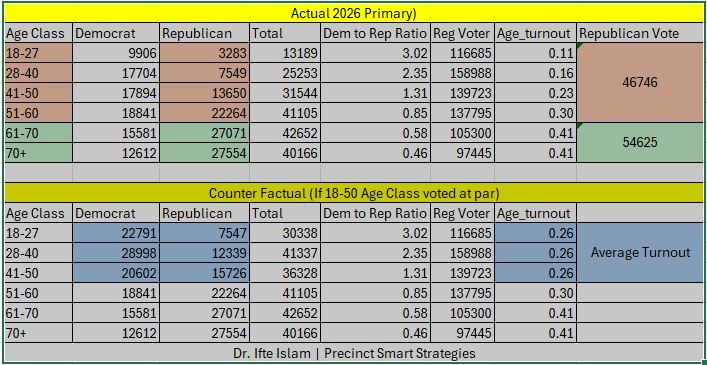
Something interesting shows up when we look closely at the 2026 Collin County primary numbers. The outcome may have less to do with party loyalty and more to do with who actually votes.
Look at turnout by age:
- Ages 18–27 → 11% turnout
- Ages 28–40 → 16% turnout
- Ages 41–50 → 23% turnout
- Ages 51–60 → 30% turnout
- Ages 61–70 → 41% turnout
- Ages 70+ → 41% turnout
That means someone over 60 was almost four times more likely to vote than someone under 30.
Now here’s the key part.
Younger voters strongly favored Democrats in this primary:
- Ages 18–27 voted about 3 to 1 Democratic
- Ages 28–40 voted about 2.3 to 1 Democratic
But older voters leaned Republican:
- Ages 61–70 voted about 1.7 to 1 Republican
- Ages 70+ voted more than 2 to 1 Republican
Because older voters show up in much larger numbers, their votes dominate the final results. In fact, voters over 60 alone produced more than 54,000 Republican votes in this primary.
But what happens if younger voters turn out at a similar rate to everyone else?
I ran a simple scenario: what if voters aged 18–50 voted at around 26% turnout instead of the much lower rates we saw?
The results shift dramatically.
Higher participation from those groups would add roughly:
- 26,900 more Democratic votes
- 11,100 more Republican votes
That’s a net gain of about 15,000 votes for Democrats — enough to completely change the outcome.
In other words, Collin County elections may not be as one-sided as they appear. The biggest difference right now is who shows up.
There are huge numbers of registered voters under 50 in this county. If even a modest share of them became more engaged in primaries and local elections, the political landscape here could look very different.
And reaching younger voters today means meeting them where they already are — on platforms like Instagram, TikTok, YouTube, and other online communities where people share information and talk about issues that affect their daily lives.
The takeaway from these numbers is simple:
The future of elections in Collin County may be decided less by persuasion and more by participation.